NFTs in 2026: What’s the Real Future After the Hype?
The NFT market has matured. As speculative hype fades, NFTs are evolving into digital infrastructure for ownership, identity, gaming, and real-world assets. Here’s what the future of NFTs could look like in 2026.

NFTs have gone through one of the fastest boom-and-bust cycles in crypto history. What once sold for millions is now often worth only a fraction of its peak price. By 2024–2025, the market clearly matured, and speculative hype faded.
But NFTs did not disappear.
They evolved.
By 2026, NFTs are expected to play a quieter but far more meaningful role in the digital economy.
The End of the Speculative NFT Era
The early NFT boom was driven by excess liquidity, social hype, and limited understanding of long-term value. Many projects had no utility, no revenue, and no clear future use.
As markets matured, prices corrected sharply. This was not the failure of NFTs, it was the market removing speculation from a technology that was misunderstood.
By 2026, NFTs will no longer be treated as lottery tickets.
NFTs Shift From Assets to Infrastructure
The biggest change is how NFTs are used.
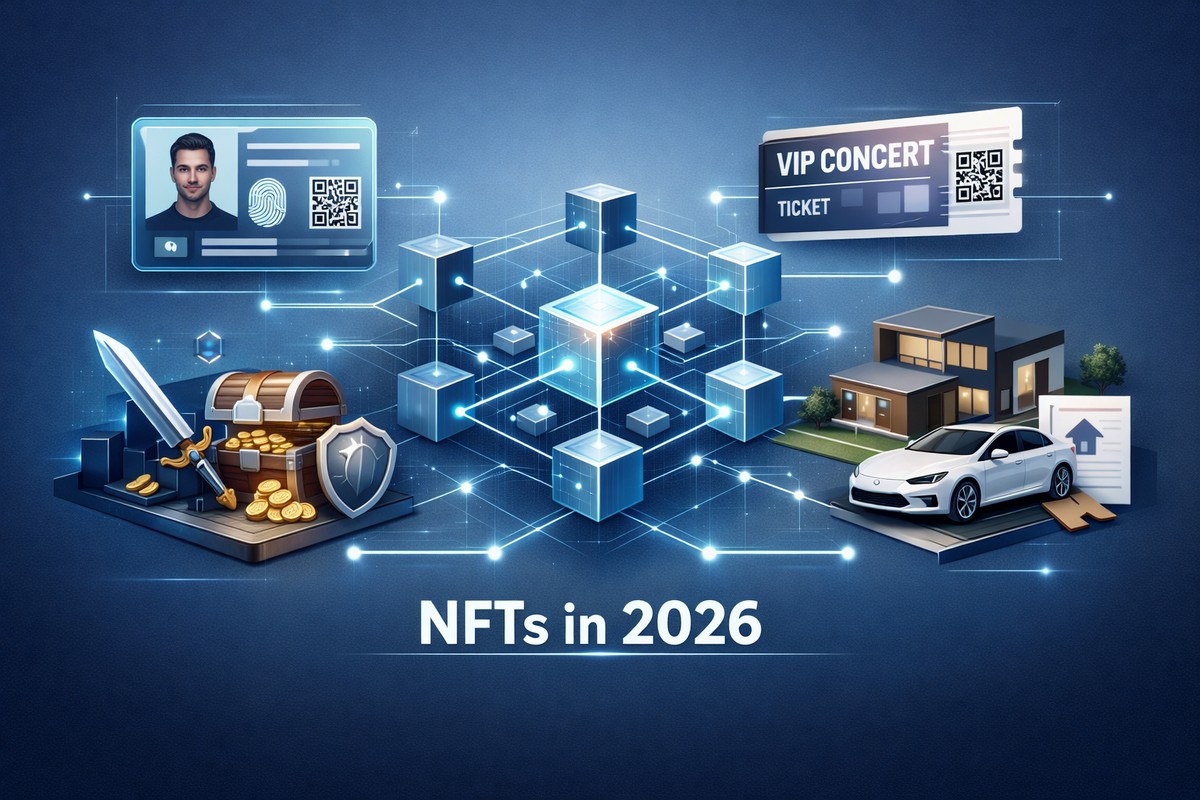
Instead of being sold as investments, NFTs are becoming digital ownership tools. They work quietly in the background to prove identity, rights, access, and authenticity.
Most people in 2026 may use NFTs without ever calling them NFTs.
Digital Identity and Credentials
One of the strongest NFT use cases lies in identity.
NFTs can represent:
- Educational certificates
- Professional licenses
- Membership credentials
- Digital IDs
These NFTs are usually non-transferable and exist purely for verification. Governments, universities, and enterprises are already experimenting with this model.
Gaming and Digital Ownership
Gaming remains one of the most natural homes for NFTs.
In 2026, NFTs are expected to power:
- In-game items
- Skins and collectibles
- Digital land
- Player-owned assets
Unlike earlier hype-driven games, future NFT gaming focuses on ownership and interoperability rather than speculation.
Ticketing, Access, and Events
NFT-based ticketing solves real problems.
Fraud, duplication, and scalping are major issues in traditional ticketing systems. NFTs allow tickets to be verifiable, programmable, and traceable.
By 2026, concerts, conferences, and sports events may use NFT tickets without marketing them as “crypto.”
NFTs and Real-World Assets
NFTs are increasingly used to represent ownership and rights, while fungible tokens handle value.
Examples include:
- Property ownership records
- Royalties and IP rights
- Supply chain certificates
- Carbon credits
In this model, NFTs become a critical layer in real-world asset tokenization.
Enterprise and Brand Adoption
Brands are no longer selling NFTs as collectibles.
Instead, they use NFTs for:
- Loyalty programs
- Customer rewards
- Product authentication
- Exclusive access
The word “NFT” often disappears, but the technology remains.
What NFTs Will Not Be in 2026
It’s important to be realistic.
NFTs in 2026 will not:
- Guarantee fast profits
- Replace traditional art markets
- Trade at extreme valuations without utility
Speculation fades. Utility survives.
NFTs didn’t fail, they were simply ahead of market understanding. Just like the internet survived the dot-com crash, NFTs are settling into their real role as digital infrastructure rather than speculative assets.
By 2026, they will support ownership, identity access, and rights across digital and physical systems. The future of NFTs is not about hype or headlines, but about usefulness.
The next chapter belongs to builders, not flippers.